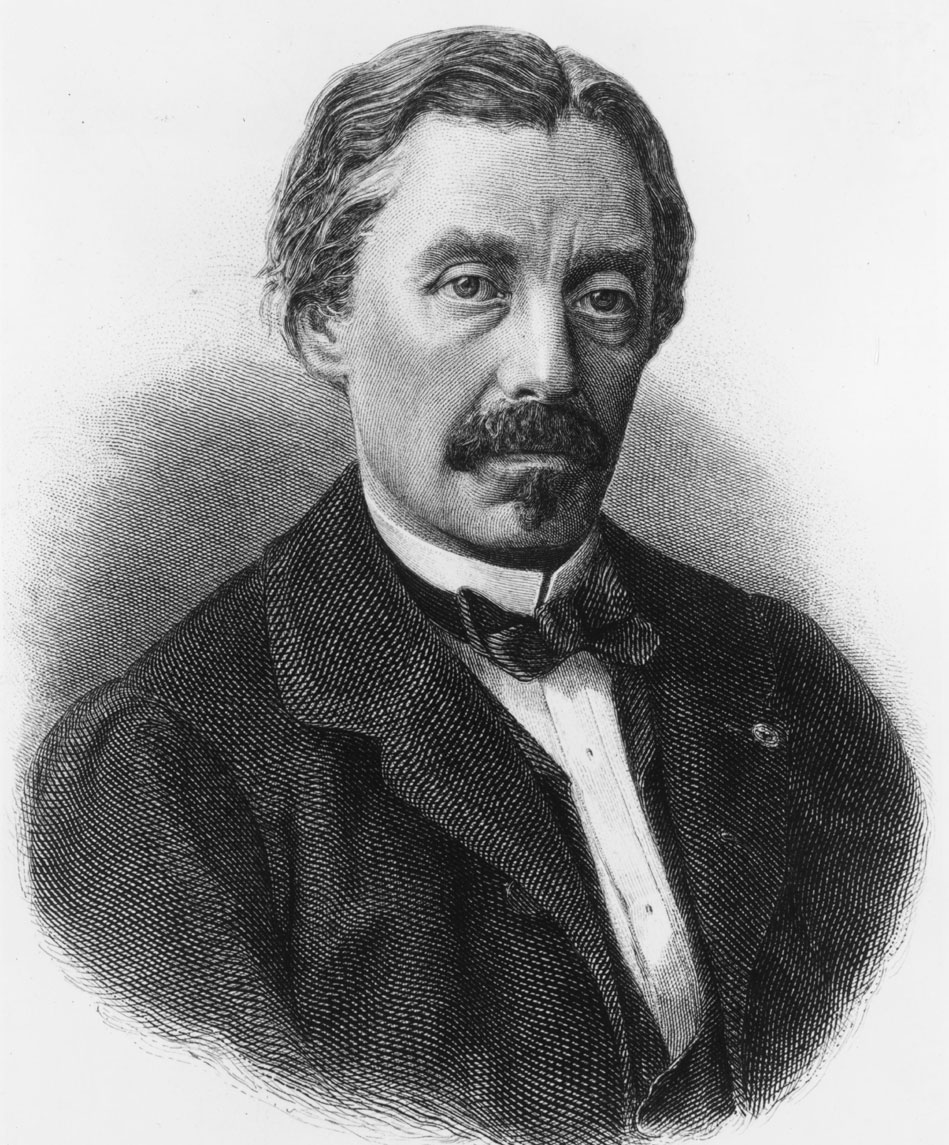
Portrait of Léon Foucault (image credit: Encyclopedia Britannica)
By 1850 there was little doubt that the Earth rotated. The new physics ushered in by Newton's Principia made sense of both the Earth's orbit and the Earth's rotation. The cartographic work by French scientists showing the Earth's oblate shape provided indirect evidence for Earth's daily spin. But there was still no simple way of demonstrating the rotation of the Earth. The experiments with falling balls were too hard to perform and too fraught with error to serve as a convincing demonstration.
This situation would finally be remedied by the French physicist and instrument designer Jean Bernard Léon Foucault (below). Foucault was already well known for his experiments on light, particularly his measurement of the speed of light in collaboration with Hippolyte Fizeau in 1850. While machining a steel rod for a new instrument, Foucault noticed that the vibrating rod continued to vibrate in the same plane even as the rod spun on a lathe. This observation suggested that a pendulum might maintain its plane of oscillation even as the Earth rotates beneath it, so that observers on the rotating Earth would see the pendulum's plane of oscillation appear to rotate (or precess) in the opposite direction.