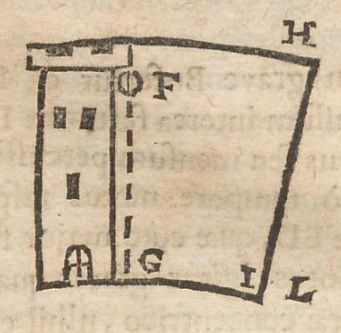
Diagram of a ball dropped from a tower from Dechales' 1671 treatise Cursus seu Mundus Mathematicus. (image credit: Wikimedia Commons)
Aristotle believed that all objects near Earth were composed of four elements: earth, water, air, and fire. He believed that objects made of earth would naturally fall directly toward to the center of the universe. This explained why heavy objects (which are mostly earth) fall, and why all of that earth has accumulated to form a sphere centered on the center point of the universe. Aristotle thought it would be unnatural for that earth to move around the center point, so he believed that the spherical Earth must be stationary.
Aristotle and his followers had other arguments against a rotating Earth, such as the "tower argument." Suppose you drop a rock from the top of a tall tower (see below). According to Aristotle the rock should fall straight toward the center of the universe (which is also the center of Earth), landing at G in the diagram. However, if Earth is rotating, then while the rock is falling the tower should move a significant distance to the east, ending up at point I in the diagram. Thus, you should see your dropped rock land far to the west of the tower's base. But this never happens! The rock always lands at the base of the tower just below where you dropped it. So, argued the Aristotelians, the Earth must not be rotating.
Copernicus countered the tower argument by claiming that both the tower and the rock are part of what we might now call the "Earth system." Everything in the Earth system rotates together, so when the rock is dropped it not only moves downward but also moves eastward along with the tower (and everything else on or near Earth). In that case, the dropped rock behaves the same whether the Earth is rotating or not. That at least made a rotating Earth possible, but it did not serve as a convincing argument that the Earth really did rotate. Copernicus also argued that it was better for the small Earth to rotate than for the enormous Celestial Sphere to rotate, but Aristotelian natural philosophers, who thought it was natural for the Celestial Sphere to rotate and unnatural for the Earth to rotate, disagreed.